
Now, in the era of Fiscalization 2.0, when every stage of business processes is under growing demands for transparency, the electronic invoice has become the standard. It is no longer just a legal obligation but an opportunity for companies to optimize their internal processes and make employees’ work easier. Since September 1, 2025, the new Fiscalization Act (NN 89/25) has entered into force in Croatia, with its application for taxpayers starting on January 1, 2026.
Where are the problems?
The introduction of Fiscalization 2.0 and mandatory e-Invoices brings a major digital change to the Croatian economy. Experts point out that the system will, in the long run, increase transparency, speed up processes, and reduce administration. Still, entrepreneurs are already reporting a series of problems.
The first challenge is the lack of an official validator and test environments, which makes it difficult to check whether the system works. Uncertainty about the choice of information intermediaries further increases insecurity, and contractual relations are often not clearly defined. Implementation costs particularly affect small businesses and crafts, while larger companies struggle with complex ERP integrations. Deadlines create pressure because instructions and technical specifications arrive too late. An additional obstacle is the new KPD 2025 classification of products and services, where entrepreneurs have difficulty finding the appropriate codes. Accountants and staff require additional training, and communication with state institutions is often unclear.
Experts also warn of risks: penalties for incorrect invoices, delays in cooperation with partners, and problems with document archiving. If all these challenges are not resolved in time, the greatest burden of the reform will fall on small and medium-sized enterprises.
One of the key challenges companies face is precisely the processing, approval, and linking of invoices with orders and contracts. Traditional manual processes create slow bottlenecks and open the door to errors, and this is where digital solutions like Ensolva come in.
Centralized e-Invoice Management
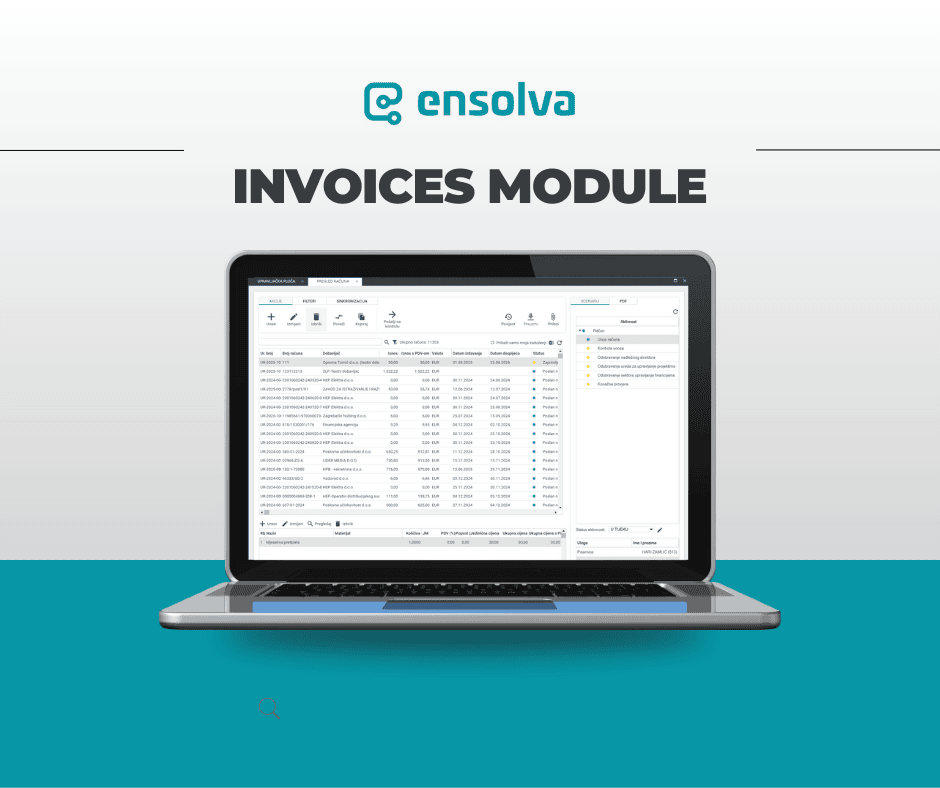
The Ensolva Invoices module was designed as a central hub for receiving, processing, and approving invoices. By automatically importing e-invoices from FINA (or another provider a company uses), the need for manual entry and document searching is eliminated. This greatly speeds up the work of procurement and finance departments, while all invoices and supporting documents are available in one place. Beyond registering data, the module allows users to review and search invoice items and link them with purchase orders and contracts. In this way, a clear trace is ensured from the contract to the final payment.
Flexible Workflow and Audit Trail
Every company has its own approval policies and hierarchy. Ensolva enables the approval process to be digitally adapted to those rules. For example, approvers can be automatically assigned based on invoice value, department, or type of cost. In addition, each action is logged in the system, ensuring complete transparency and a full audit trail. This removes any uncertainty about approval status while making the process faster and more reliable. Users can also approve invoices via e-mail, further accelerating procedures and reducing administrative workload.
Practical Examples: HPB and Zagrebački Velesajam
The benefits of invoice digitalization are best illustrated through client experiences.
- Croatian Postal Bank (HPB) uses the Ensolva Invoices module to simplify its complex approval system. Invoices are automatically imported from FINA, pass through the defined approval process, are linked with existing orders or contracts, and only then enter the ERP system—already approved and ready for payment. The Finance Department therefore has real-time insight into the status of every invoice in one place.
- Zagreb Velesajam, as a public contracting authority, uses the module in the same way, demonstrating that the system works equally well in both the private and public sectors. Transparency, invoice status visibility, and reduced administration are the key benefits for both types of organizations.
Advantages for Procurement and Finance
By implementing the Invoices module, you gain:
- faster and simpler processing – e-invoices are automatically imported into the system
- document linking – every invoice item can be connected to a purchase order or contract
- digital and flexible approval – workflows tailored to internal company policies
- complete audit trail – all activities saved in the system
- ERP integration – approved invoices synchronized and ready for payment
- practical reports – invoice lists easily exported in Excel format
Time for Action
The initial cost may be higher, but savings over time, combined with better liquidity, error reduction, and lower costs of paper and physical delivery, can bring significant benefits. Invoice management should no longer be a tedious and slow process. Solutions such as Ensolva make it possible for invoice receipt, processing, and approval to run smoothly, digitally, and fully transparently. Invoices can be processed automatically, which reduces delays and speeds up liquidity. Most importantly, we are finally aligning with EU standards, which enables interoperability and facilitates international business relations.
So the question is no longer whether to digitalize invoice processes, but are You already!