Artificial intelligence is becoming an increasingly important part of business, raising questions about how it works, which tasks it can take over from employees, and how best to use it in everyday work. Its value lies not only in the speed at which it performs tasks, but also in its ability to free up time for activities that require knowledge, experience, and human judgment.
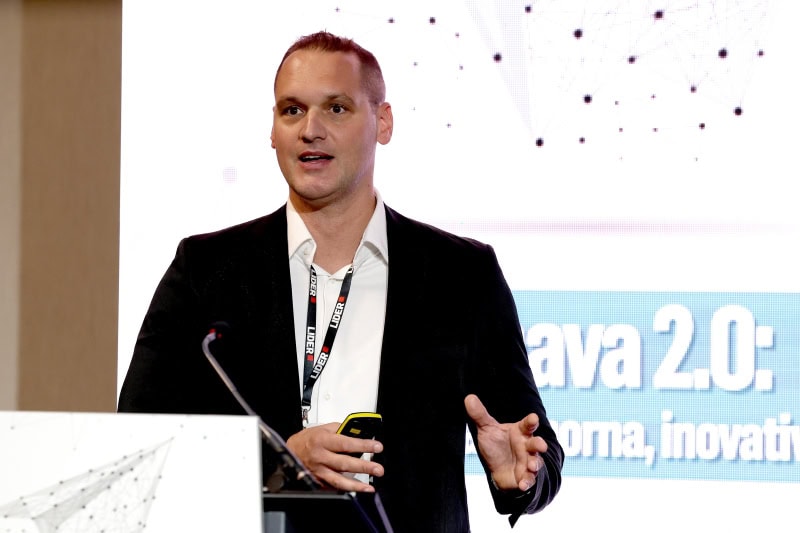
Daniel Pavlić, Director of the Ensolva department at RIS, addressed these topics at the 21st Lider Procurement Conference in Zagreb. As part of the conference, “Procurement 2.0: Strategic – Resilient – Innovative,” he explained how language models work and how artificial intelligence can support everyday business tasks.
Procurement 2.0: Strategic, Resilient, and Innovative
This year’s Lider Procurement Conference focused on the changes shaping procurement and its role within organizations. What does it mean to be a strategic business partner today? How can organizations build resilience in an uncertain environment? And how are technology, sustainability, and innovation changing procurement? These were some of the key questions addressed at the conference.
Speakers explored different aspects of modern procurement. Miodrag Šajatović offered a broader economic perspective, while Antonio Trotta and Andrea Nativi discussed business and supply chains. Svjetlana Jerković connected sustainability with strategic transformation, and Helena Popović Petrušić spoke about procurement as a business partner that understands organizational needs and contributes to creating value.
Huso Hasanović and Gordana Gelenčer discussed organizational change, while Noel Yuen broadened the discussion on procurement’s role in today’s business environment. Lana Ilović and Luka Kaučić explored technologies that will shape the future, while Daniel Pavlić and Sead Begić presented opportunities for applying artificial intelligence.
The conference’s overarching message was that procurement now plays a much broader role than simply managing costs and operational processes. It contributes to business decisions, strengthens organizational resilience, and can be an important driver of innovation and long-term competitiveness.
What Actually Happens When We Ask AI a Question?
When we ask ChatGPT a question, the answer appears on the screen almost as if by magic. Behind it, however, lies a complex process.
In his presentation, Daniel explained how AI models learn from vast amounts of textual data. Text is broken down into smaller units called tokens, which are then converted into mathematical representations. Using these representations, the model learns relationships between words and how their meanings depend on context.
The same word does not always mean the same thing. Its meaning depends on the sentence in which it appears and the situation in which it is used. Recognizing these relationships is a key part of how language models learn.
The model then generates a response step by step, predicting which piece of text should come next based on the context established so far.
This does not mean that every answer is necessarily correct. AI can make mistakes or provide a convincing response that does not reflect the facts. That is why it is important to understand how it works, where its limitations lie, and when human verification is necessary.
Understanding the technology is not just a technical matter. It helps us better assess where AI can genuinely be useful and where we should not rely on it without further verification.
How Much Time Do We Spend on Tasks That Don’t Need to Be Done Manually?
Perhaps the even more interesting question is what AI can change in our everyday working lives.
Think about a typical workday. We read documents, search for information, check statuses, write emails, and try to find the right file among dozens of others. Each task takes time. Added together, they can account for hours that we might be able to use differently.
Daniel highlighted these types of activities as areas where AI assistants and agents can take over part of the workload.
“There is no longer a need for us to spend time on these things, allowing us to free up that capacity for other tasks,” was the message behind his presentation.
This does not mean that every task will automatically disappear or that every process can be fully automated. It means we should start identifying activities that do not require constant human intervention and consider how to carry them out more efficiently.
What if we could spend less time searching for information and more time analyzing it? What if we could spend less time on administration and more time talking to suppliers, identifying risks, and finding better ways to achieve business goals?
That is where AI becomes much more interesting than simply generating text.
What Does This Mean for Procurement?
This is particularly important for procurement. Procurement professionals work with large volumes of data, documentation, and information that must be brought together to support sound decisions.
At the same time, procurement is increasingly expected to be more than a function that processes procedures and requests. It is expected to be a business partner that understands organizational needs, identifies savings opportunities, and actively contributes to planning.
AI can help free up time for precisely these activities. It can support document reviews, summarize information, prepare meeting materials, and assist with other tasks that take place before decisions are made.
However, technology alone does not make procurement strategic. What matters is how we use the time it potentially frees up.
If we use that time simply to complete even more administrative tasks, we miss part of the opportunity. If we use it to better understand internal stakeholders’ needs, negotiate more effectively, and play a more active role in business decisions, AI can become an important part of transforming the way we work.
AI Can Help, but Responsibility Remains Ours
There is another important condition: AI must be used thoughtfully.
A model can generate an answer that sounds convincing but contains an error. That is why it is important to verify results, establish clear rules for use, and ensure that activities can be tracked.
In his presentation, Daniel emphasized the importance of transparency and traceability. When AI is involved in a business process, it must be clear what has been done and how individual activities have been carried out.
This is particularly important in procurement, where decisions can have direct financial consequences and affect supplier relationships. AI can speed up information processing and help prepare decisions, but it does not eliminate the need for accountability, professional expertise, and human judgment.
Technology delivers the greatest value when we understand what to expect from it and know how to use its results appropriately.
What Should We Leave to People?
At the end of his presentation, Daniel returned to a question that should be at the heart of every conversation about artificial intelligence: what do we want people to do when they no longer have to spend so much time on routine tasks?
“We should not have to use the human brain for every task,” was the message that summarized his vision for the use of artificial intelligence.
Instead of spending our energy on repetitive work, we can direct it toward things that technology cannot easily replace: talking to people, negotiating, understanding needs, building relationships, and making decisions that require experience and judgment.
This represents an important shift in perspective. We should not only ask how AI can help us work faster, but also what we can do with the time it frees up.
For procurement, this can mean more room for strategic thinking, better collaboration with the rest of the organization, and a greater contribution to business results.
Technology Is a Tool. We Create the Value.
Participating in the 21st Lider Procurement Conference was an opportunity to explore these questions—not only what artificial intelligence can do today, but also how we want it to change the way we work.
Daniel’s presentation reminded us that behind advanced models and new capabilities lies a simple business idea: we should use technology to help people direct their knowledge, time, and abilities toward the areas where they matter most.
The future of procurement will not depend solely on how many new tools we introduce. It will also depend on how effectively we connect technology with people, processes, and business goals.
AI does not have to do everything for us. It simply needs to help us free up time for what truly makes a difference.